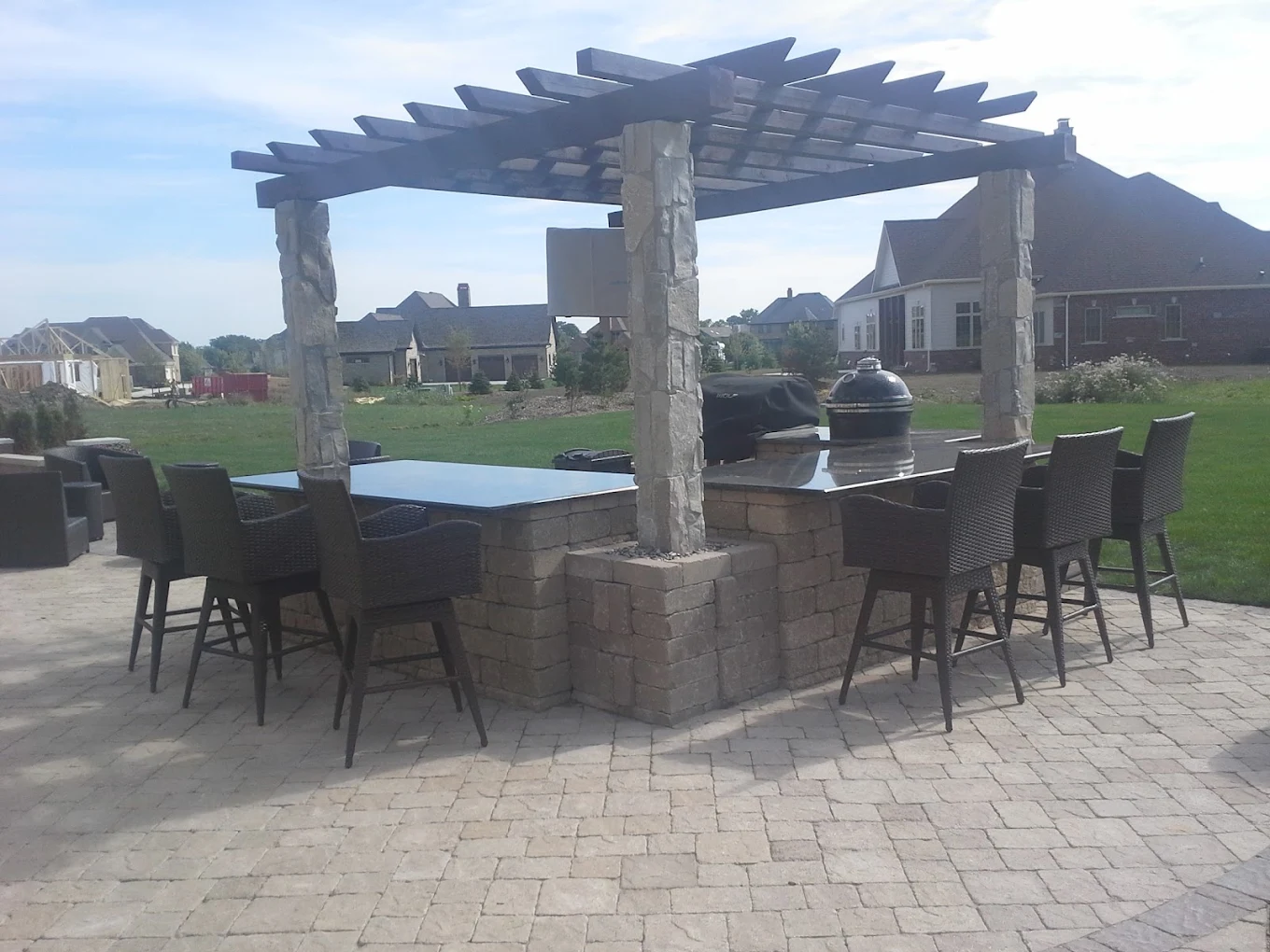
Trend #1: Year-Round Outdoor Living
The biggest shift we've seen in recent years is homeowners wanting to use their outdoor spaces beyond June, July, and August. In Wisconsin, that means designing for shoulder seasons — and even winter.
The features driving this trend:
- Fire pits and outdoor fireplaces: The single most popular addition to SE Wisconsin landscapes right now. A fire feature extends comfortable outdoor living from late March through November — and creates a gathering point that draws people outside even on cool nights.
- Covered structures (pergolas, pavilions): A pergola with a canopy or solid roof panel extends usability through summer rain and creates a defined "room" outdoors. We're installing more pergolas with retractable shade systems than ever before.
- Radiant and infrared heating: Increasingly common on covered patios — especially for homeowners who entertain into fall and early winter.
- Wind screening: Lattice panels, planted evergreen screens, and privacy walls that block prevailing winds make shoulder-season use dramatically more comfortable.
We completed a number of full outdoor room projects in 2026 — patio + pergola + fire feature combinations — and the demand continues to grow. Homeowners are treating their outdoor square footage as seriously as their indoor square footage.
Trend #2: Native Plants and Low-Maintenance Landscapes
The era of high-maintenance, water-hungry turf grass as the default backyard is fading. More SE Wisconsin homeowners are moving toward:
- Native prairie plantings: Prairie dropseed, coneflower, black-eyed Susan, and native grasses that thrive in Wisconsin soil without supplemental irrigation or fertilizing once established
- Pollinator gardens: Deliberate planting designed to support monarch butterflies, native bees, and other pollinators — increasingly requested by homeowners with kids and grandkids
- Reduced lawn area: Converting sections of maintained lawn to planted beds, groundcover, or hardscape — reducing mowing requirements and water usage
- Ornamental grasses: Low-maintenance, four-season interest, and movement in the landscape — Karl Foerster and Shenandoah switch grass are popular choices locally
Native plantings look especially good when combined with naturalistic hardscape — irregular flagstone, gravel paths, and boulder accents rather than rigid geometric layouts.
Trend #3: Multi-Zone Outdoor Spaces
Homeowners are increasingly thinking about their outdoor space in zones — much the way interior designers think about open floor plans. Rather than one large undifferentiated patio, the goal is distinct areas with different purposes:
- Dining zone: A defined area sized for a table and chairs for the household, with overhead structure and lighting
- Lounge/conversation zone: Lower seating around a fire feature, separate from the dining area
- Play zone: A defined lawn area or recreational space, often edged in low plantings or a border to visually separate it from hardscape
- Transition zones: Walkways, stepping stone paths, and plantings that connect zones without requiring you to step onto grass
Multi-zone design works best when planned as a whole from the beginning. It's one of the reasons we advocate for designing the complete vision even when the installation will be phased over multiple years.
Trend #4: Hardscape-Forward Designs
For many SE Wisconsin homeowners, the ideal yard has less grass and more durable, usable surface. The hardscape trend shows no signs of slowing:
- Large-format pavers: 24x24 and larger format pavers are growing in popularity — they create a cleaner, more contemporary look
- Retaining wall seat walls: Walls that serve double duty as seating — eliminating the need for additional patio furniture while defining the space
- Permeable pavers: Systems that allow water infiltration rather than runoff — increasingly popular with homeowners facing drainage challenges
- Staircase as feature: Broad, low-rise stair systems that serve as the architectural centerpiece of a landscape rather than just a functional element
Hardscape offers a long-term payoff: once installed correctly, it requires minimal maintenance and holds its value. Compared to lawn maintenance costs over 10–15 years, well-installed hardscape often pays for itself.
Trend #5: Thoughtful Outdoor Lighting
Outdoor lighting has moved well beyond security floodlights. The trend now is layered, architectural lighting that extends how the space looks and functions after dark:
- In-cap step lighting: LEDs integrated into retaining wall caps and step risers — subtle, safe, and stunning at night
- Path lighting: Low bollard and ground-level path lights that guide movement without creating harsh brightness
- Uplighting on trees and structures: Grazing light on stone walls and textured surfaces creates dramatic shadow and depth
- String lighting: Still popular, especially on pergola structures — creates warmth and ambiance for entertaining
- Smart control: Low-voltage LED systems with timer or app control are increasingly standard on our projects
Good landscape lighting adds perceived value, improves safety, and dramatically extends the hours of enjoyment from an outdoor space investment.
How to Incorporate These Trends on Your Budget
You don't need to do everything at once. Here's how to think about phasing trend-forward elements into your project:
- Phase 1 — Foundation: Install the hardscape correctly (patio, walls, grade) with future zones in mind. Conduit for lighting installed now costs a fraction of adding it later.
- Phase 2 — Structure: Add a pergola, fire feature, or outdoor kitchen once the base hardscape is complete.
- Phase 3 — Softscape and lighting: Plantings and lighting are often most impactful after the hardscape reads clearly.
Even a modest budget can deliver a cohesive, on-trend result when the design is planned correctly from the start. We work with homeowners across the budget spectrum — from focused single-feature installs to comprehensive multi-phase transformations.
See examples of recent projects in our project gallery, or learn more about how our design and installation process works.